
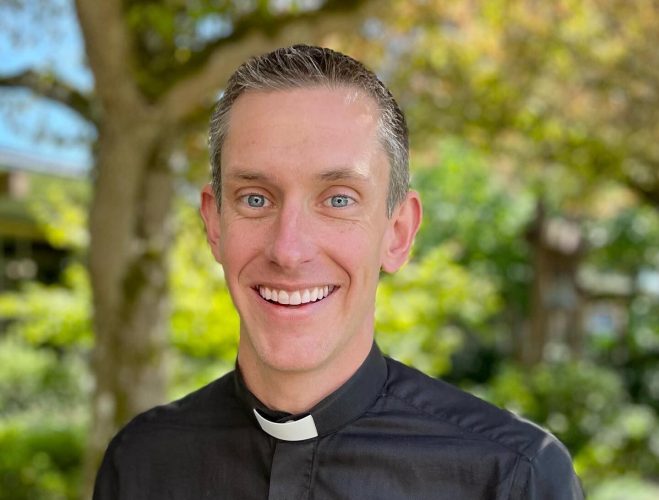
August 9, 2026 | Proper 14 Sermon | The Rev. Brian Gregory
Life sure has a way of beating you down sometimes. It can be unpredictable, unsettled. Good fortune can change in an instant. Life can feel unfair – for us and for others. Some people feel like they always draw the short straw. Sometimes the rug seems to get pulled right out from beneath us. When were down and it feels like we’re getting kicked by this life, it is easy to feel utterly abandoned and alone, and that there is no hope for anything different.
In readings this morning, we have two stories of those who found themselves in places they didn’t hope for or imagine. Those who seemed to have it all going for them, and then life happened and storms – literal or figurative – arose.
On the one hand we have the story of Joseph. If getting sold into slavery by your brothers because they couldn’t stand you doesn’t count as getting beat down in life, I don’t know what does. You’ll recall, as we have been following the story of Abraham and Sarah’s family since the end of May in this Season after Pentecost, that Joseph’s family was one of promise. God had promised Abraham and Sarah that, through them and their descendants, God would make a great nation that would bless the world. It was not an easy, linear journey for God’s promise to this family to materialize. Abraham and Sarah doubted whether it would ever come true as they faced infertility. When the promise of a child was fulfilled, the family faced tests of their commitment to God and God’s promises. The family turned on itself for birthrights and blessings. But this morning, we arrive with Abraham’s grandson, Jacob, and his family, settled, finally, in the land God had promised Abraham and Sarah. They seemed to have made it.
I imagine Joseph had a lot of hope for his life. God gave him dreams of greatness – dreams in which his family gathered around him in honor, bowing down to him in submission. The problem for Joseph was not just that his father loved him more than his brothers, but also that he told his family about his dreams. Pejoratively, his brothers started calling him “the dreamer.” And so they devised a plan to get rid of him. It was only at the last minute that they spared his life, not as an act of mercy, but as an opportunity to make a buck while still making him disappear from their lives.
Joseph, it seems, was lost to Egypt and it would be easy to give up there. But what the lectionary reading today, nor the continuation of the story next week don’t cover is that captivity in Egypt was not the end of Joseph, nor the end of the story. Our reading from the Psalms recounts the rest. Joseph held onto hope. “God was with Joseph,” the writer of Genesis tells us. Beginning as a slave in Egypt, Joseph ultimately rose to power In Egypt, becoming second in command under Pharaoh. Through his leadership, the Egyptian people and far off foreigners, including his own family, were saved from destructive famine. But even that is not the end of the story. The story will continue that, with Joseph’s family in Egypt after him, they grew so large and powerful in Egypt that they were taken into captivity as slaves, preceding God’s saving acts in the exodus. Again, life has a way of beating down sometimes. The “good” moments of life – when things seem settled and right – nor the hard moments are the end. Fortunes, “settledness,” captivity, the storms, come and go. So how do we continue in faithfulness in the good times and hold onto hope when things fall apart?
On the other hand this morning, we have a story of a literal storm in which Jesus’ disciples found themselves. This group of 12 ragamuffin men who had encountered Jesus and left everything they had to follow him when he called had been on a wild ride. They had witnessed miracles and healing. They had seen God’s power in Jesus and, I suspect, felt like they were on top of the world with a front row seat to marvelous things. Just before getting into the boat in which they sat as the storm arose on the lake, Jesus had fed 5000 people with five meager loaves of bread and two fish. I wonder if they were still talking about it on the water, marveling about how there was nothing this Jesus seemed unable to do.
But then the storm. Many of the disciples were fisherman so rough water was nothing new to them. But night fell and they were far from shore, working against the wind as the waves battered the boat. Since many of the disciples were fishermen before Jesus had called them, perhaps they were confident in the boat’s ability to keep them safe until the storm subsided; perhaps they remembered that they had been caught in a storm on the lake a few chapters earlier in Matthew’s gospel – but that time with Jesus who calmed the story – and wished that he was with them this time, too, to make the rolling waves stop. Regardless, they were helpless in the midst of the storm and could do nothing but go along for the wild ride of wind and wave.
What is interesting to note, however, is that we are not told the disciples were terrified until a figure appeared walking towards them on the water. Jesus was with them…they just couldn’t believe it was him. Even after Jesus told them it was him, they still didn’t believe. Peter needed proof, “Lord, if it is you, command me to come to you on the water.” Peter wasn’t supposed to be on the water – none of us are made to walk on water. We’re made to be in the boat, at least then there is some protection from the storm. Perhaps in faith, perhaps in disbelief, when Jesus said, “Come,” Peter did. And the water held for as long as he focused of Jesus. But the waves and the wind drew his attention and into the water he went. Taking his eyes of Jesus, the one in which he found hope, proved perilous. And yet, Jesus was still there, still quick to reach out his hand to save Peter.
The thread through both of these stories – Joseph being sold away and the disciples finding themselves in the middle of a lake – is that storms happen. Life happens. We’re not as in control as we might like to think. And, to some extent, I think we all know this from experience. Storms happen around us, they happen to us, they happen in us. Sometimes they creep in slowly. Other times it feels like we are just doomed because we can’t even remember a time when things felt right with the world or our life. Sometimes, there is a sudden change like going from the high of seeing the miraculous to being tossed about and being utterly out of control. The question, though, is how we respond in the moments when life goes off the rails. What do you do when everything you thought you believed and could count on is turned upside down? Who do you turn to in the moments when life just feels unfair? Do you hold onto hope that the present is not the last word…that there is hope for calm after the storm?
Because both of these stories that we read – while seemingly dire in the midst of them – are not the end of the story. The story of our faith, the story of Jesus, the story of the whole of Scripture, is that God is not done; that there is always hope. Sometimes in obvious ways, sometimes as a still small voice that beckons through the sound of the wind and waves of life, Jesus calls us to follow him and promises that new life – life that is deep and true and whole – is coming.
It is not often that I tell personal stories in sermons. Not because I don’t want you to know me, but because I don’t want to be the subject or the focus of the gospel – of good news. But there are times when stories beg to be told. My sometimes stubborn insistence on hope is not theoretical. It comes from experiencing storms of my own.
From the beginning of my life, I was raised in a Christian home and, for as long as I can remember, have called myself a Christian. I have a vague memory of sitting on the bathroom counter in my childhood home, brushing my teeth, and asking Jesus into my heart when I was three. My family went to church every Sunday and my life and faith were deeply formed by the pastors, Sunday School teachers, youth leaders, and the church community that taught me about this person named Jesus. On the surface, everything was great…but I didn’t let people see the reality of my life, the depths of my hurts, or how consumed in a vicious storm I was.
From my sophomore year of high school to my sophomore year of college, I found myself caught in an all-consuming addiction to cough medicine. In that season of my life, I lost all sense of purpose, all sense of who I was, and all hope that it would ever end. I broke each and every relationship in my life. I no longer knew who I was or where God was in the midst of it all. I found myself in a storm that never seemed to end. I found myself in hell – a hell that it felt like I had created and could not escape.
After four years of running, four years of losing any trust my family and friends ever had in me, and being arrested four times for stealing my next high, I finally broke. I gave up and left for what I describe as the best and worst month of my life in drug treatment. It was there, as I came face to face with my deepest disappointments, longings, and failures that I learned to hope again. It was there that I discovered that God is greater than any of my hurts, greater than my despair, stronger than any storm, and more full of redemption than I could ever have imagined.
You see, for my entire life, in the words of Paul’s letter to the Romans, I had “confessed with my mouth that Jesus is Lord.” But it wasn’t until I was at my lowest and learned to hope again that I “believed in my heart that God raised him from the dead.” And if God could raise Jesus from the dead, if resurrection is real, then perhaps I could experience life of hope and meaning and purpose once again. Perhaps even I could be saved.
That is why I preach the way I do; why I feel called to those on the margins, the lonely, those beat up by life; why ministries like One Parish One Prisoner are so dear to me. It isn’t because I’ve studied theology or read the Bible – though those things have given words and a framework and the substance of my faith – it’s because I’ve been in that boat in the middle of a lake, utterly helpless being tossed around by life. I’ve felt the pain of losing any sense of home or promise and been captive like Joseph. And I’ve seen Jesus show up in the midst of it, offering hope and comfort and companionship, promising that the dark present is not the end.
I don’t know all the storms you are weathering right now. I don’t know what storms are in your past or your future. I don’t know the storms those in our lives, in our neighborhood, in our community are facing. But we all need a little hope sometimes. And it is here that Paul’s rhetorical questions are timely: how are people to have hope – how are they to know that Jesus gives hope – unless someone shares it with them? That sounds an awful lot like evangelism…and evangelism can be a scary (or sometimes, in the Episcopal Church, a 4-letter) word.
But evangelism, at its heart, is simply telling your story. In the world of addiction and recovery, it is summed up in the 12th step of AA: “Having had a spiritual awakening as the result of these Steps, we tried to carry this message to alcoholics.” That message, like the Gospel, is a message of hope – that something can come after the dark storm of the present. Evangelism is not about convincing others of something. It’s not a set of propositions. It’s about story and testimony. It’s coming alongside someone who finds themselves in a storm, longing for hope, and telling them about the time that Jesus showed up for you and helped you weather the storm. Because we all need a little hope sometimes.
Maybe you are the one in the storm at the moment. Maybe you are looking out into the darkness, longing to see something, someone, anything coming to save you. First off, you are not alone. The God who raised Jesus from the dead is not through with you. We are here with you…even if just to huddle in the boat together and wait for the storm to die down. Maybe the latest storm has passed for you and you have seen hope realized. Even then, you’re not off the hook. You have a story to tell. You are called to be a witness to the hope we find in Jesus. Because we all need a little hope sometimes.